Don't give up on the public just yet
Research suggests people will defend democracy — if they know what it is.


VIENNA — Former U.S. President Joe Biden tried to raise the alarm about the threat that Donald Trump and his movement posed to "the very foundations of our republic." Days before the 2024 election, Vice President Kamala Harris, speaking at the site where her Republican opponent incited the Jan. 6, 2021, insurrection, warned that Trump was "consumed with grievance and out for unchecked power."
It didn't work, at least if the measure of success was preventing a plurality of the American electorate from returning a would-be autocrat to power. Democrats, per the post-election consensus, spent too much time warning about abstract threats and not working with the voters that actually exist: people who want to hear about prices ("kitchen table issues"), not a lecture about civics.
People "can't pay for groceries with democracy," political consultant Louis Perron wrote following the 2024 contest.
The median voter, in the pejorative sense, is largely motivated by vulgar self-interest: cheap gas and consumer electronics. Others cast their ballot based on a desire to inflict harm on the disfavored; on racism, xenophobia and hatred of women. That is, at least, a defensible reading of an electorate that returned the worst possible option to power.
But even if we should avoid romanticizing the common citizen, we should also avoid writing them off as a lost cause. Indeed, research suggests someone can vote for an authoritarian (more than once) and still learn to value democracy — and vote accordingly, going forward, even if they ignored such appeals in the past.
"A lot of people tune out," Anja Neundorf, professor of politics and research methods at the University of Glasgow, noted in a recent talk in Vienna. They do not grasp the real-world implications of democracy being eroded, perhaps — or because those warning about it are partisans for the other side of the political aisle, they ignore the warnings and rally behind the threat to the republic.
"It's messy and complex and it's natural for us when we see something that is so complex, to just tune out," Neundorf continued, addressing an audience at Friedrich Ebert Stiftung, a social democratic think tank. "But if we empower people by explaining them what [democracy] is, how it works and why it's good for you, then you empower them."
Put another way: If you teach people why it matters for the press to be independent and diverse, as a basic first principle, they will be primed to defend the values of liberal democracy without further prompting when they see them under attack.
Neundorf was not speculating. As part of a project funded by the European Research Council, she and a team of researchers used Facebook and Instagram to present three-minute civic courses to more than 90,000 people in 33 countries who agreed to participate for a chance to win an Amazon gift card. What they found is that simple, animated and kind of cheesy lessons about democracy — what it is and why it should matter to you — promoted a statistically significant change in people's opinions and even their voting intentions.
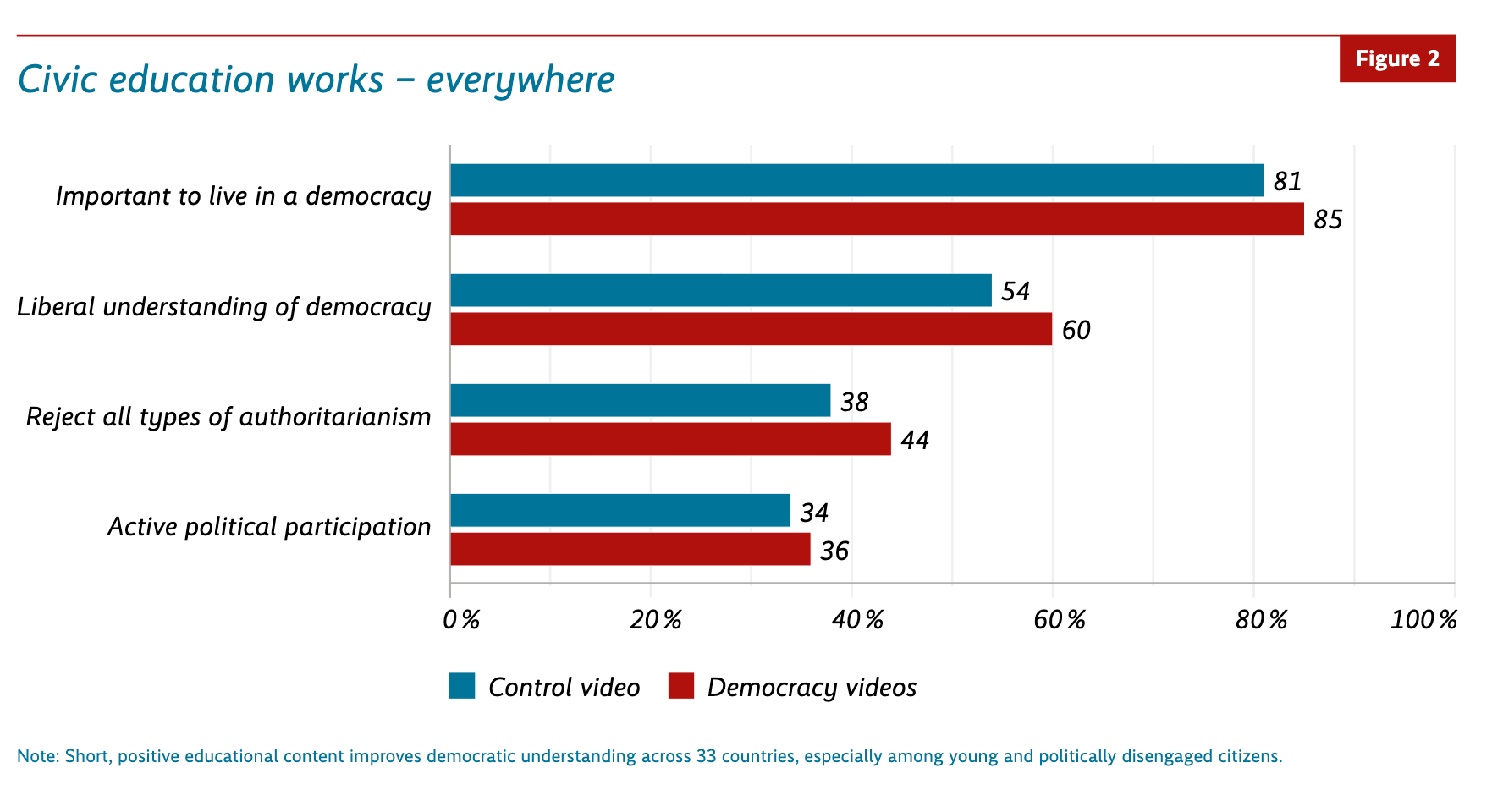
Crucially, the study found not just that these lessons changed people's take on the abstract concept of "democracy," but how they perceived threats to it. In Turkey, watching the lessons was associated with a 5 percent drop in support for the ruling party of strongman Recep Tayyip Erdoğan, despite the fact that neither he nor his government were ever mentioned. The effects of watching a 180-second video were even measurable some 10 weeks later.
"Something that maybe we wouldn't have expected is that the message that actually worked the best was to emphasize the core of liberal democracy," Neundorf said. "The media that focused on rights and the media that focused on institutions worked better than focusing on people."
These messages about rights and the importance of checks and balances wereeven more effective than economic claims, like the fact that living in a liberal democracy is broadly associated with better material outcomes for regular people.
Maybe the public is not so bad? Or rather: its constituent parts can be persuaded to stand up for their own rights.
At least in this one exercise. And it is just an exercise. The question is: Can something like this — civic lessons delivered via social media platforms that are increasingly under the control of right-wing oligarchs — be replicated in the real world?
For the chance to win a $500 gift card, people will watch a civics lesson on their phone. For free, though? Why would you? There's a cat video to watch, or some AI-generated Dachshunds fighting over a stuffed animal.
That's a real and unsolved problem. If you can get someone to take their pills, they may heal; if you can them to learn about civics, they may even defend democracy. But you need to figure out a way to make people actually take the medicine.
One of the videos that researchers found to be the most effective.
The messenger is part of the problem. Biden and Harris were partisans whose remarks could be dismissed as self-interested. Both would have been better served by their administration exercising power — quickly and aggressively prosecuting those who organized the effort to overthrow the republic — than issuing warnings that were dismissed as partisan politics. But what about everyone else? The American media treated the election as any other, with "both sides" leveling embellished claims about the other; while the American public should not be spared its share of responsibility, it's not hard to imagine someone concluding that this was just another contest between two teams that always get a little heated.
Neundorf suggested that education should be an all-society effort, not the responsibility of politicians alone. That means: you, me and civil society. She did not, like anyone else in our present world, have an easy answer as to the form and means of distribution. What she did present, however, is an encouraging insight in a discouraging time: that people can be made to care about democracy, and that they can be made to so based on principles, not just their pocketbook.
Follow The Redoubt on Bluesky and Facebook.
More than hot takes: This original reporting is funded entirely by readers like you.
Support us with a paid subscription or one-time donation.