The far right is still not the future
From America to Europe, most people don't share the values of right-wing extremists.


VIENNA — When Donald Trump won the 2024 U.S. presidential election, it was hard not to conclude in the days following that the end — for honor, decency and the progressive left — was very much near. American voters, given a choice between a qualified Black woman and an unqualified white racist, went with the man who said Haitian immigrants eat cats and dogs.
The election, in a bad year for incumbents everywhere, was decided by a swing of a few percentage points. The American people, as a whole, did not go fascist, even if a plurality of those went to the polls did indeed vote for fascism.
For democracy and human rights, it was a devastating blow that will have ramifications for a generation, even if America's course were corrected tomorrow. For the far-right in Europe, it was an inspiration — a sign that the future was theirs.
Just days before 77 million Americans returned Trump to power, the Freedom Party, founded by old Nazis, won the most votes in Austria's legislative elections.
"The men and women of Austria have made history today," FPÖ General Secretary Michael Schnedlitz said of his party's 28.8 percent in the polls, enough to make it the largest party in parliament and earning it first dibs on forming a governing majority.
It didn't get far.
"Everybody thought, 'this is a done deal.' But, somehow, they were not willing to compromise," Dr. Filip Milačić, a senior researcher at the Friedrich Ebert Foundation and visiting professor at Central European University, said of the FPÖ.
Speaking in a crowded cafe in the heart of liberal Vienna, Milačić credited Trump with making the FPÖ believe the far right's global ascendence is practically inevitable. So far, at least, that hubris has kept them out of power.
"Even though they won 28 percent of the vote, they behaved like they won 40," Milačić said. "After Trump's victory, they thought that the zeitgeist had changed — that time is on their side," he said, a phenomenon that threatens to both radicalize and undermine the far right across Europe. "In other countries, you can see something similar: that the far right is not willing to compromise, but becoming more and more radical because they think they are the future."c
Instead of forming a government, Austria's far-right has had to watch from the sidelines as the country's conservative, liberal and social democratic factions united for a grand coalition designed to keep them out. And now the continent’s right-wing extremists, once buoyed by thoughts they soon would get a chance to "Make Europe Great Again," are being forced to distance themselves from their American counterpart and his brand of tariff-happy imperialism.
The groundswell that isn't
Far-right parties are getting more votes, in Europe and elsewhere, and the threat they pose to democracy is real. That is neither in doubt nor, necessarily, a reason for pessimism over the long-term. Consider the places where it is strongest and what has been required to both attain power and keep it: in short, deception — lies about their governing intentions — and efforts to silence, using the levers of the state, any and all dissent. For all their bluster, these far-right movements are not confident that they enjoy popular support.
In Hungary, Prime Minister Viktor Orbán has spent the last 15 years turning his country into a laboratory and international model for "illiberal democracy." This project maintains the facade of democratic norms, holding regular if not necessarily free and fair elections, but its leaders openly declare national sovereignty and "traditional" values more important than checks, balances and equal rights.
Since 2010, Orbán and his party, Fidesz, have taken over state media and seen their allies take over most private outlets, denying platforms to their opposition; declared war on NGOs and "woke" academia, forcing the Central European University to move most of its operations to Vienna; stacked the judiciary with loyalists; and waged never-ending culture war at the expense of democratic values, most recently by trying to ban LGBTQ+ Pride events.
The American right is openly envious of this model. Vice President JD Vance has explicitly praised Hungary's assault on education, and Orbán is a regular guest at Mar-a-Lago. Speaking at the 2025 Conservative Political Action Conference, hosted in Budapest, Orbán praised organizer Matt Schlapp for recognizing "that what we can do here on a small scale, on the scale of Hungary, can be done on a large scale — in America."
But while Hungary's authoritarians govern as if they enjoy the overwhelming support of the masses, the reality is that Orbán pursued a revolution without ever campaigning on it and has barely held onto power despite exercising near-total control over state institutions and media.
In 2010, when it came to power in the wake of a massive corruption scandal, Fidesz and its right-wing partners won just under 53% of the vote. Because of how seats are awarded, however, Orbán and his allies ended up with a two-thirds super-majority in the Hungarian parliament, enabling it to purge the country's judiciary, pass sweeping legislation without any court review and ultimately rewrite the nation's founding charter.
"During the election campaign in 2010, Fidesz never said it would change the whole constitutional system, so it is difficult to claim that the election was a referendum on a new constitution," Kim Lane Scheppele, a Princeton University expert on autocracy, noted in 2013 testimony before the Helsinki Commission.
That's important to recognize: While there are of course committed ideologues among the electorate, most people — including may who vote for right-wing parties — are not themselves right-wing radicals. They may well fall for right-wing talking points and culture wars, but what the average person wants is not a revolution.
Denying a mandate
That's true even in the United States, where, in 2024, Trump returned to power on a platform of somehow making everything cheaper. He promised mass deportations in what was the most racist campaign in modern American history, to be sure, but he also disavowed any intention of pursuing a total right-wing remodeling of the federal government.
"I have nothing to do with it," Trump, on the campaign trail, said of Project 2025, the hard-right Heritage Foundation's policy agenda for his second term. Since winning the election, though, he has "implemented or is in the process of implementing about half of Project 2025's proposals," including its call to completely "dismantle the administrative state," according to the Annenberg Public Policy Center at the University of Pennsylvania.
"The people voted for major government reform, and that's what people are going to get," Elon Musk, the billionaire who led the Department of Government Efficiency, claimed.
That's the thing, though: As much as voters should have known better than to believe a lie, it is a lie they were told. How could they reasonably be said to have voted for something the candidate denied any intention of doing?
Anyone claiming an unambiguous mandate for whatever Trump wants is not grappling with what was said, before he took office, and the data since his second term began.
In July 2025, according to one Gallup poll, a record-high 79 percent of U.S. adults say that "immigration is a good thing," including 64 percent of Republicans. Some 85 percent of those surveyed said children brought to the U.S. illegally should be offered the chance to become citizens; 78 percent said the same of undocumented immigrants overall. Just 38 percent expressed support for what is now U.S. policy: "Deporting all immigrants who are living in the United States illegally back to their home country."
By January 2026, a plurality of survey respondents even told YouGov that it was time to abolish Immigration and Customs Enforcement.
This is, from the perspective of a fellow citizen, rather contemptible. Trump, if anything, promised at rallies and on campaign signs: "Mass Deportations Now." Some of the people that pollsters are interviewing are surely lying, perhaps even to themselves. Recriminations, though, are best left for family gatherings. In the world of politics and the game of winning state power, it's a reminder that voters are not always rational; their votes are not clear expressions of policy preferences; and their views are not static.
Liberal politicians ignore this at their own peril. When consultants and others push watered-down xenophobia, they only increase the salience of anti-immigrant politics — there must be a problem if everyone says there is — while depriving the electorate of a meaningful choice. In 2024, Vice President Kamala Harris campaigned not on "open borders" but on a smarter, more humane crackdown on immigration, legal or otherwise; it was the safe play but it didn't work.
Even after Harris' loss, Democrats continued to read the electorate as demanding that they, the opposition, simply offer a more competent alternative to Trumpist xenophobia. Amid the 2025 summer immigration raids in Los Angeles, for example, Sen. Chris Murphy, D-Conn., continued to champion his support for a "bipartisan bill" that "would have stopped all asylum seekers from being released into the country."
"It gave [the president] emergency power to shut down the border," Murphy boasted on social media.
The rejoinder is that, if someone believes exercising the legal right to seek asylum should be punished with incarceration, they are unlikely to prefer a Democrat over a Republican. And liberal voters may wonder: If that's the choice we're being given, why even bother?
"In a way, they are saying to the public: you know, the far right is right, but don’t vote for them, which doesn’t make sense at all," Milačić told The Redoubt. "They are acknowledging the rhetoric of the far right and partly emulating it. And then this is a kind of self-fulfilling prophecy: They are legitimizing this rhetoric and then making it more popular."
 Charles R. Davis
The politics of hating immigrants
Europe is no different than the United States in this regard, as Vanderbilt Prof. Larry M. Bartels observed in his 2023 book, "Democracy Erodes from the Top."
For all the talk of a populist surge and political realignments, he observed that relatively little attention had been paid to how successful reactionaries in Eurpe — from Hungary's Fidesz to Poland's Law and Justice — actually got into office. A closer examination does not reveal the mandate that is often claimed.
"It was only after gaining power," Bartels wrote, "that these rather conventional-looking conservative parties embarked upon the project of 'illiberal democracy.'"
It has never been terribly popular. In Poland, for example, the right-wing Law and Justice Party was thrown out by voters after it attempted an Orbán-style, anti-democratic "revolution" in its own country; this, after first running on competence and opposition to corruption.
Indeed, despite all the media attention and justified fears over the rise of the far right, the public remains fundamentally decent and committed to the values of democracy and tolerance.
Relying on data from the European Social Survey, a biannual academic study of public opinion conducted across more than 30 nations since 2001, Bartels noted that the rise in anti-immigrant parties across the continent was not accompanied by a rise in anti-immigrant sentiment among voters. This is despite the continent having faced a major economic downturn and subsequent influx of millions of refugees, and media coverage that treated immigration as an emergency and populist demagogues as channelling popular discontent.
"Remarkably," Bartels wrote, "given the widespread perception of an 'immigration crisis,' the overall trend in public support for immigration was generally upward, with the average level of support across Europe gradually climbing from 5.1 on the zero-to-ten scale before the onset of the [2007-09] economic crisis to 5.7 in 2018-2019."
Speaking to The Redoubt, Bartels explained that there's a tendency among reporters, pundits and the politicians who read them "to overestimate the electoral importance of issues and ideology and to underestimate the importance of social identities and appeals to peace, prosperity and social order." The belief, he said, "is that, if voting patterns shift, there must have been some momentous shift in citizens' preferences. But in most instances where populist parties have gained substantial support, the primary cause has been prosaic failures of governance by established parties."
This is easy enough to see in the United States with its two-party system, where the primary way to express discontent with the status quo is to vote for the party that is out of power, one of which has now been captured by anti-democratic extremists. But the media and political class also treats election outcomes rather differently: Trump's narrow 2024 victory with a plurality of votes is treated as a mandate for generational change, while his predecessor's larger win in 2020, with a majority of the vote, was treated as a return to America's default setting – and met with calls to compromise and reach across the aisle to the losing seditionists.
Per Bartels, "there is a substantial tendency for journalists and those who read them to exaggerate the recent successes of populist parties, and thus to overreact to those successes."
Take the Netherlands: In 2023, Geert Wilders and his anti-immigrant party won the most votes in the Dutch election, prompting outlets like Time Magazine to run pieces explaining how the far-right extremist achieved a "resounding victory over his mainstream rivals."
Two years later, the electorate shifted and Wilders was thrown out of government, losing to a center-left party, Democrats 66. Instead of embracing its rivals' talking points, the party emphasized tolerance for and indeed solidarity with immigrants, making explicit appeals to voters with a "migration background" and pledging to end "institutional racism."
"Whoever we are, whatever we look like, whoever we love, or whatever we believe in: every person must be given the space to build a good life," declared the party's campaign platform.
It's a blow to the politics of concession, or the idea that liberal parties can only win by offering more humane version of right-wing policies on culture and migration. But as Bartels said, "I'd guess that a comparison of the media's coverage of the 2023 and 2025 elections ... [would] reveal a lot more attention to Wilders' rise than to his fall."
Indeed, Time Magazine did not report on the outcome of the latest Dutch election; its last piece ran before the vote, noting that Wilders’ party was in the lead.
“Journalists find it very hard to resist dramatic, scary stories," Bartels noted. Responsible adults promising competent governance? It’s too decent to go viral.
We need readers like you to support our independent journalism.
Consider a paid subscription or one-time donation to help us keep covering the global fight for democratic values.
You can also sign up to receive our weekly newsletter, full of original reporting and progressive analysis, and a monthly dispatch with exclusive commentary on international affairs.
The importance of an alternative
As the Dutch elections show, liberals do not have to cosplay as reactionaries to win an election. The same has proven true in Austria, where in 2016 the Green Party's Alexander Van der Bellen easily defeated the far-right Freedom Party's candidate, Norbert Hofer, in the final round of voting to become president. Instead of mimicking his opponent during the campaign and conceding there was a problem when it came to immigrants, "Van der Bellen was unapologetic about his stance on welcoming refugees, his support for the EU and conviction that the Schengen treaty is a cornerstone of Europe’s stability," per Politico. He handily won reelection in 2022.
According to Milačić, Van der Bellen's approach can be a model. Too many on the center-left fight defensive and at times apologetic campaigns, ultimately standing for the status quo — its positive attributes but also all the baggage — rather than offering a cohesive, confident and principled vision for the future.
"When you talk about identity — national identity and patriotism — many on the left are really allergic. I think this is a mistake," Milačić said. "Personally, I have no attachment to the concept of ‘the nation.’ But this is not preventing me from seeing that I’m a minority. Because for many people, the nation as a group, as a concept, is very important."
Austria's left-wing activists have also toyed with this notion. Ahead of 2025 municipal elections, guerrilla artists put up posters in Vienna that used the aesthetic of 1930s fascism and the slogans of fascist partisans (think: "Defend the homeland!") but paired it with calls for welcoming immigrants and driving out the hatemongers. In this version of nationalism, it was diversity and open borders that made the city great, not exclusion and homogeneity.
 Charles R. Davis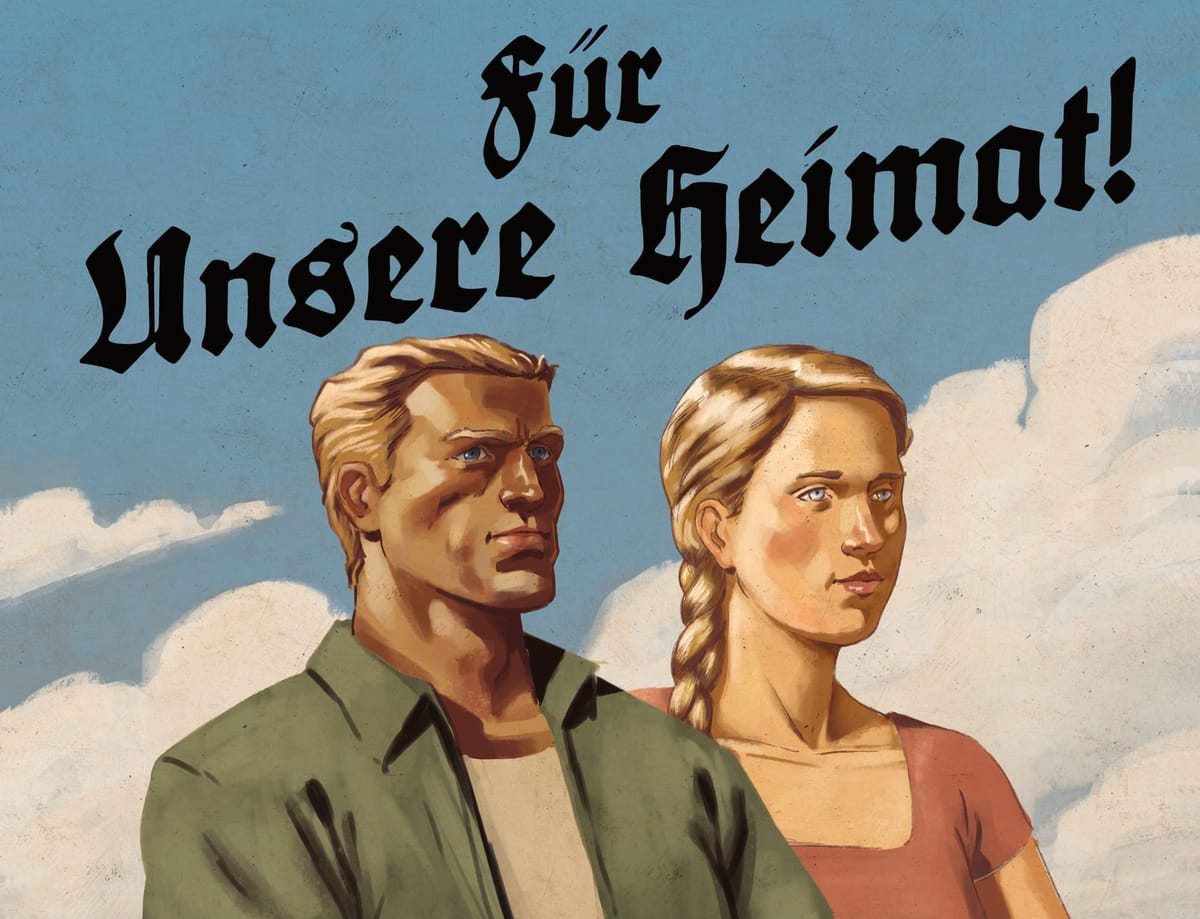
Liberal nationalism was also deployed in the Netherlands. The leader of Democrats 66, Rob Jetten, opposed the far-right's policies without conceding the terrain of national identity, describing himself as a "progressive patriot" who was truer to the country’s tradition of liberalism.
"I believe that it is important progressive parties also show that we can be proud of our country," Jetten said, encouraging supporters to wave the flag and nearly tripling Democrats 66's seats in parliament from 2023 to 205.
The American analogy is "No Kings": the protests that frame opposition to Trump and his consolidation of power as an affront to the country's revolutionary, anti-monarchal history. Liberals and the left need not whitewash their country's spotty history but, instead, frame themselves as the heirs to its proudest traditions – and as the ones determined to realize its noblest aspirations.
This approach can be seen in a recent speech from Rep. Maxwell Frost, D-Fla., one of the youngest members of Congress.
"For so long, the right-wing has held up patriotism as a vibe, as an aesthetic. But patriotism is more than 'bald eagle, flag and beer.' Patriotism is about loving the people who live in the damn country," Frost said at a rally in Washington, DC, following the state killing of Renee Good. "If you fight for the rights of immigrants, you're a patriot," he added on social media.
"I'm not saying you need to emulate the right," Milačić said, but instead offer "an emotionally compelling counter-narrative." Instead of accepting public opinion as static and regressive, he argued, the left can win by offering a genuine alternative to the inherent ugliness and instability of right-wing populism in governance.
Despite the small margins of their losses, "somehow the political elites on the left and center-left [have been] convinced that the electorate shifted to the right, so they shifted," Milačić said, referring to the anti-immigrant but center-left governments presently ruling Britain and Denmark. "They completely misread the whole situation," Milačić argued. "They are adapting to the narrative, in terms of the agenda of the far right, which is a big mistake."
The answer is not to copy the right's policies but to offer an earnest alternative to bigotry. What the far right gets is that "emotions matter in politics," Milačić said. "They have a very clear message, and they have a message that is very emotional."
So offer something similarly emotional but positive and inspiring; an actual vision for a progressive, diverse nation that makes no apology for defending liberal values. Most people vote on vibes, not their careful readings of policy, and the alternative — abandoning one's convictions for techocratic versions of one's opponents' policies — is a good way to project weakness.
To take one recent example: New York City elected a democratic socialist not because it suddenly lurched to the far left, but because the democratic socialist was confident and personable, talking on the campaign trail as if he were a real human being familiar with the average person's problems; even Trump couldn't resist the Zohran Mamdani charm.
Not every election will or can be won by a charismatic liberal, and right-wing voters are not all suffering false consciousness. But despite what algorithms may feed up on social media, the truth is that the far-right's arrogance is not matched by public opinion; normal people do not want to return to the 1930s. The challenge, for progressive politicians and others who object to government by and for the worst among us — for weird ideological projects and wretched cults of personality — is to stand up for them and the values of liberal democracy, and to do so without apology.