For some, freedom of speech is already gone
Foreign-born academics are afraid to speak their mind in Donald Trump's America.
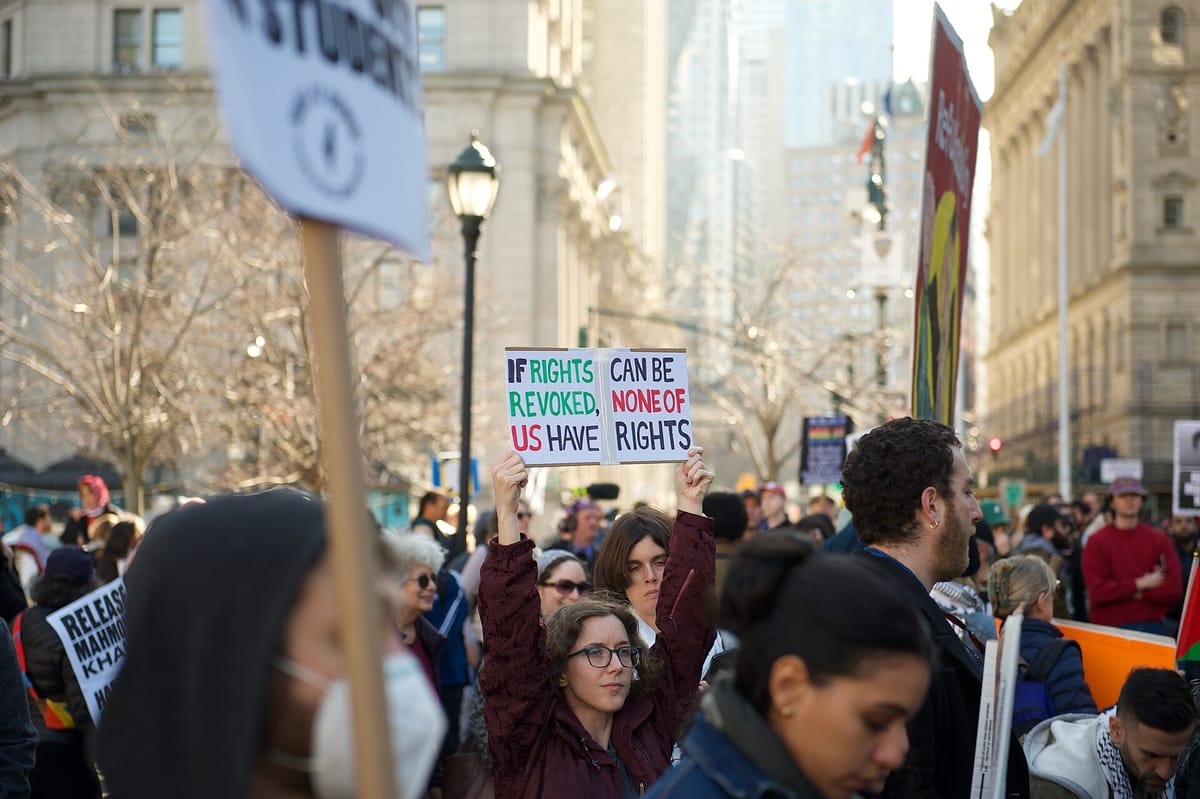
These are not conversations one would have about a thriving democracy.
In interviews with a dozen European academics and officials, the United States was repeatedly likened to an adversarial, authoritarian state in the fashion of Russia or China. Since Donald Trump's return to power, those who still live there are looking to get out, while those who already left are glad they did.
It's just not a free country anymore, at least by the test: Can you say that and be sure there won't be trouble?
“I’m worried talking to you,” one professor, a green-card holder now residing in a red state, said in an interview. “This is maybe not the smartest thing for me to do, to say things that are critical of the administration.”
The detention of journalists Don Lemon and Georgia Fort has shown that not even U.S. citizens can safely voice (or observe) criticism of the Trump administration without fear of reprisal from the federal government. The killings of Renee Good and Alex Pretti by masked federal agents, thus far with impunity, show there can be even darker consequences for opposing this administration.
"It definitely made me feel a bit uncomfortable,” a German-born researcher, presently at a federally-funded U.S. laboratory, said of remaining in America. They recently made the decision to leave, citing, in part, the loss of academic freedom and the fact that one can no longer "explore some research topics freely due to political reasons."
Indeed, to obtain funding and retain employment, researchers must avoid any mention of certain sensitive topics in their grant requests (like “women” and “people of color”). In some states, professors cannot discuss the topic of gender (or Plato) in the classroom without fear of termination.
In this way, freedom of speech has already been lost. But it's not just funding and career advancement at stake: every European academic still in the U.S. expressed concern that voicing even mild criticism of the federal government could cost them their visa; those outside the U.S. worried it could deny them entry.
 Charles R. Davis
“The beauty of the U.S. academic system was that it attracted talent from all over the world,” said another German-born professor. They recently chose to leave an elite American university. If they stayed, they reasoned, they would always fear losing their legal status — and with it, their livelihood.
It's not just Trump, though.
Nearly 80 million Americans voted for the president, and some of them go to college, where they have been encouraged by groups like Turning Points USA to expose “woke” professors. Teaching is now a minefield, where students will claim "liberal bias" over a lesson on gerrymandering.
It leads to self-censorship in a setting that requires freedom of speech. And outside the classroom, the risk is worse than cancellation: this government could try to deport you. For anyone carrying a foreign passport, the wisest action, if not most courageous, would be to remain silent.
“You think, ‘Yeah, you should be careful,’” the president of an Austrian university said in an interview. They left the U.S. in 2024 but still have friends, family and professional opportunities there. Is it safe, then, to talk about Donald Trump?
The U.S., however flawed, was once seen as a free and open society. You could at least say: I don't like the government.
That is not how it is viewed today, including by many of its own citizens.
One academic, originally from Austria but now a naturalized U.S. citizen, said they were afraid to speak freely, citing the Trump administration's plans to strip citizenship from those who obtained it "unlawfully."
The law is now wielded according to the arbitrary grievances of a 79-year-old man. Would you take the chance? Immigrant or otherwise, many Americans are discovering that an assault on the rights of one group can undermine the rights of all.
As the professor noted, there are now risks to speaking out. And while those risks may be worth it, “everybody needs to be careful."
We need readers like you to support our independent journalism.
Consider a paid subscription or one-time donation to help us keep covering the global fight for democratic values.
You can also sign up to receive our weekly newsletter, full of original reporting and progressive analysis, and a monthly dispatch with exclusive commentary on international affairs.