Exclusive: ICE eyes 1,000-bed detention facilities in foreign countries
The U.S. Department of Homeland Security is looking for private contractors that could help set up "international staging areas" abroad.

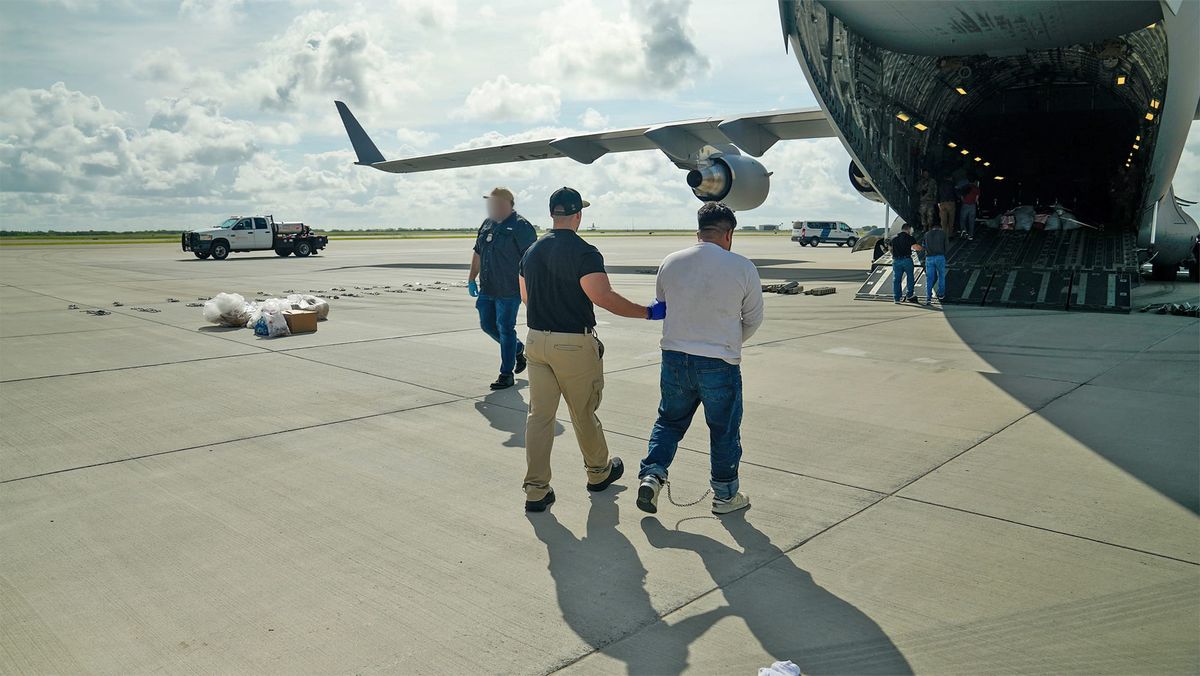
As part of its drive to ramp up mass deportations, the Trump administration is exploring the possibility of building detention facilities in other nations that could each hold up to 1,000 "illegal aliens," according to documents reviewed by The Redoubt.
The revelation is included in a posting on a federal government contracting website and indicates that the U.S. Department of Homeland Security is in the early stages of identifying potential partners in the private sector. According to the listing, DHS — specifically its sub-agency, U.S. Immigration and Customs Enforcement — would like to identify contractors that could maintain "a fleet of aircraft utilized to support removal operations for deportations," and to facilitate the removal and incarceration of deported people in facilities abroad.
In recent weeks, there has been a surge of arrests by federal immigration agents in the United States, with over 10,000 people recently detained in a span of five days. More than 63,000 people are presently in ICE custody. Two-thirds of those detained have never been convicted of a criminal offense.
A number of those arrested will be deported to places other than their country of origin. Since President Donald Trump returned to office, more than 19,000 people have been subject to so-called third-country removals. Most have been sent to Mexico, but others have been expelled to and subsequently detained in countries such as Panama, Rwanda and South Sudan.
In early July, another 11 individuals were sent to Eswatini, an absolute monarchy in southern Africa, where they are being held in a local prison with no reported date of release. Eswatini agreed to accept such deportees after signing a $5.1 million agreement with the Trump administration, an arrangement that Amnesty International describes as "unlawful." At least 30 countries have now signed similar agreements.
'International staging facilities'
Such third-country removals appear to be the motivation for possibly creating an archipelago of detention facilities for the at least temporary holding of immigrants deported from the U.S., and potentially those who were detained by foreign governments as they made their way to the U.S. border.
In a "Statement of Work" dated July 2026 and watermarked as a "draft," DHS says it is looking for a firm to operate a fleet that includes two "C-37B or equivalent Gulfstream 650ERs" and seven "Boeing 737-700's or equivalent."
The statement comes as part of a request for information, or what the department describes as "market research" aimed at identifying future commercial partners who could fulfill a future contract opportunity. But the work described by DHS entails more than just aircraft maintenance.
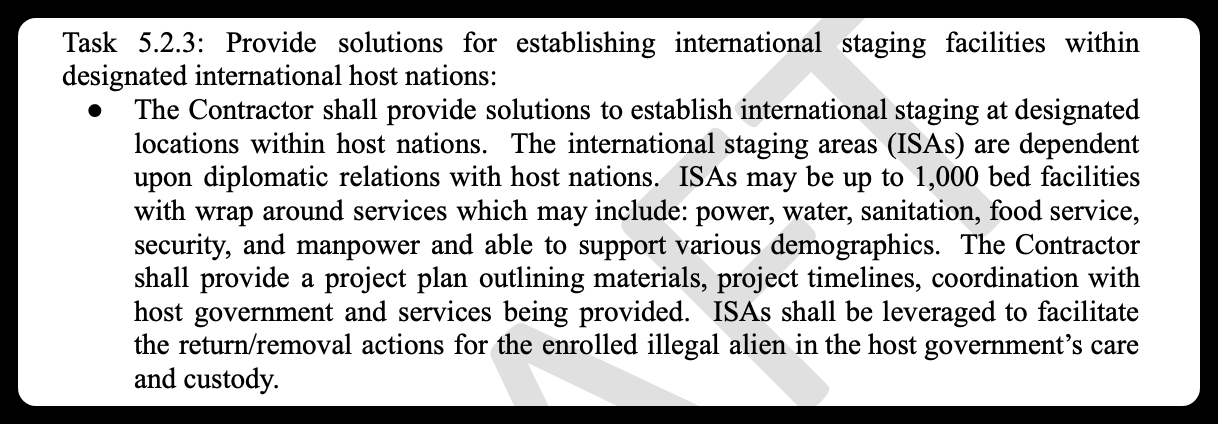
According to the statement of work, any potential contractor should, in addition to managing a fleet, "Provide solutions for establishing international staging facilities within designated international host nations."
"The international staging areas (ISAs) are dependent upon diplomatic relations with host nations," the document states. "ISAs may be up to 1,000 bed facilities with wrap around services which may include: power, water, sanitation, food service, security, and manpower and able to support various demographics."
As part of a future contract, the document continues: "The Contractor shall provide a project plan outlining materials, project timelines, coordination with host government and services being provided. ISAs shall be leveraged to facilitate the return/removal actions for the enrolled illegal alien in the host government’s care and custody."
The document was posted July 8 on the federal website for contract opportunities, with responses due by July 22. "It is anticipated that the period of performance for the required services will begin on July 28, 2027," it states. An ICE procurement officer is identified as the primary point of contact.
The Redoubt accepts no corporate or state funding. Work like this depends entirely on readers like you. Support us with a paid subscription or one-time donation.
Deportations or indefinite detention?
According to the documents reviewed by The Redoubt, any firm awarded a contract by DHS would be expected to "Provide support to the [foreign] Government to accept U.S. removals and operational transportation support to facilitate onward movement of removals," an apparent reference to third-country removals.
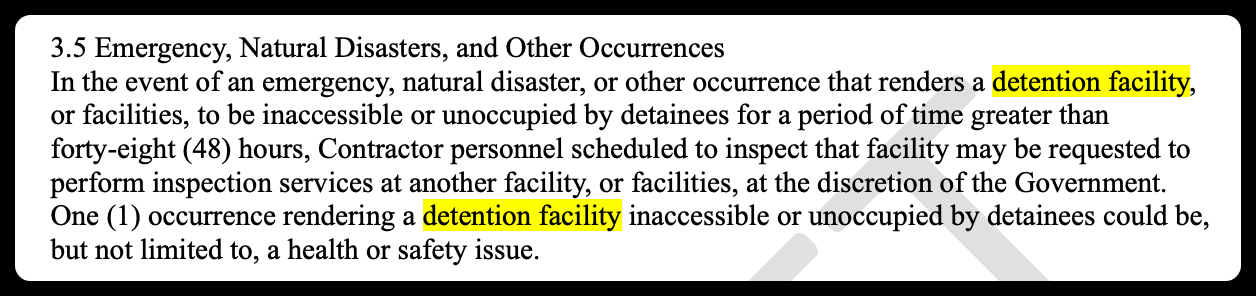
While DHS primarily refers to these potential facilities as "international staging areas," indicating they would be temporary transit points, that's not the only term it uses. In a section on emergency preparedness, the department's statement of work twice uses the term "detention facility," which suggests a longer period of incarceration.
U.S. government personnel would also be on the ground, according to the statement of work, which says the contractor would also provide "logistical/administrative support for embedded DHS Technical and Advisory Teams (DTATs) engaging with host governments."
There is also some ambiguity about who exactly would be held at these foreign facilities.
The documents reviewed by The Redoubt refer to the facilitation of removals "from host countries," and suggest that at least some of the removals would be of people in the legal custody of such hosts.
That language could be a preview of a legal strategy by the Trump administration, which might claim that immigrants sent to a foreign partner are no longer its legal responsibility, as it did with more than 250 Venezuelan nationals sent to El Salvador's Terrorism Confinement Center, or CECOT, in March and April 2025.
It could also refer to immigrants detained by foreign governments on their own territory who were believed to be headed to the U.S. border. In 2024, the Biden administration signed such an agreement with Panama to provide "equipment, transportation, and logistics for foreigners detected within migratory flows in contravention of Panama's immigration laws," a reference to immigrants from South America who had traversed the Darién Gap, an area of thick rain forest that separates Central America from Colombia.
As with that Biden-era arrangement, DHS in its July 8 posting says any potential contractor must, per the statement of work, "Provide [a] mechanism to procure equipment, materials, and/or supplies for DHS donation to Host Governments." That requirement comes just after DHS celebrated the one-year anniversary of its receiving a record-busting $165 billion appropriation from the Republican-led Congress.
 Charles R. Davis
An 'unprecedented' proposal
Unlike the 2024 agreement with Panama, however, the latest DHS proposal also calls for foreign governments to accept "U.S. removals," and to provide "operational transportation support to facilitate onward movement of removals." That, again, could refer to host nations detaining immigrants deported from the U.S., indefinitely, until their home countries are willing to accept them; it could also refer to detainees subject to the Trump administration's policy of third-country removals.
Either path would mark a dramatic escalation of the effort to carry out what DHS has described as "100 Million Deportations" from the United States, a nation of some 342 million people.
DHS's "market research" into detention facilities outside the U.S. also comes after reports of overcrowding at ICE's own detention facilities — immigrants "packed like sardines," per one Democratic lawmaker.
"The idea that the United States would establish removal staging areas in other countries, where they would potentially be jailed during a plane transfer, would be unprecedented at this scale," Aaron Reichlin-Melnick, a senior fellow at the American Immigration Council, told The Redoubt.
The creation of such staging areas could help the Trump administration avoid what happened in 2025, when a group of immigrants it sought to deport to South Sudan — a country they were not from — were held for weeks in a shipping container on a U.S. naval base in Djibouti while legal challenges played out in court.
"We know that longer international removal flights at times stop at U.S. military bases to refuel and restock, but there’s never been a significant amount of infrastructure devoted to that capacity," Reichlin-Melnick said. The "debacle" in South Sudan, he added, "is a good example of why ICE might want that capacity."
The Redoubt asked DHS for comment on Friday, July 10. Two days later, on Sunday evening, a spokesperson said the department was "actively working" on a response but indicated it would not be able to provide one by the stated deadline of Monday morning.
Foreign detention as legal loophole
The prospect of multiple, thousand-bed detention facilities funded by the U.S. government and located in foreign countries is, at the scale imagined, unprecedented. But the Trump administration would not be the first to detain immigrants outside the country.
In the 1990s, the administration of President George H.W. Bush detained more than 12,000 Haitian asylum-seekers fleeing political violence at the U.S. military base in Guantánamo Bay, Cuba. This allowed the U.S. government to deny Haitians legal recourse by claiming they were not on U.S. soil and thus not subject to its jurisdiction: they had no right to challenge their detention or have their asylum cases reviewed by an immigration judge. The policy, continued under President Bill Clinton, also enabled the U.S. to evade its responsibilities under international law, which prohibits refoulement, or sending refugees back to the danger they fled.
There was also another perk, from the perspective of U.S. authorities. An immigration lawyer who represented Haitian asylum-seekers, Ira Kurzban, told The New Yorker that the policy allowed immigrants to be held in "a place where we can keep them out of sight." As a consequence, he said, "There was a great deal of human tragedy that was hidden from the American people."
 Charles R. Davis
Andrea Pitzer, a journalist and author of "One Long Night: A Global History of Concentration Camps," said the documents uncovered by The Redoubt are "very disturbing."
"This is a proposal for a formal network of camps," she said in an interview, arguing the establishment of such facilities is, historically, "always an attempt to do some kind of end run around the existing legal system."
On July 2, for example, a federal appeals court ruled that immigrants in ICE custody cannot be held for more than 90 days without the opportunity to post bond and secure their release. Expediting deportations — even if only to a temporary destination — could be a way to evade such a requirement, which presently applies to detainees in Texas and Louisiana. That is not a bulletproof means of avoiding the law, but such rulings could spur the Trump administration to explore its options.
"And then the second thing is: Why do they need a network of thousand-bed detention sites?" Pitzer asked. "What it looks like to me is that they have hit the choke point that happens a lot with moving tremendous numbers of people through detention facilities and out to other countries."
Removing immigrants from domestic detention and sending them abroad — before a final stop is arranged — provides "less ability for legal recourse," and with it fewer opportunities for slowing down the deportation machine. It could also result in the effective disappearance of those affected.
"What happens to them will be of much less concern to almost everybody, except the immediate families of those people, and so they will be much harder to protect," she said. "I think that's a goal of this administration."
If you appreciate independent journalism, support The Redoubt with a subscription or one-time donation.