Pattern of no-bid contracts going to companies working on Trump's ballroom
Contracts reviewed by The Redoubt call into question White House claims that the ballroom would never cost taxpayers a dime.

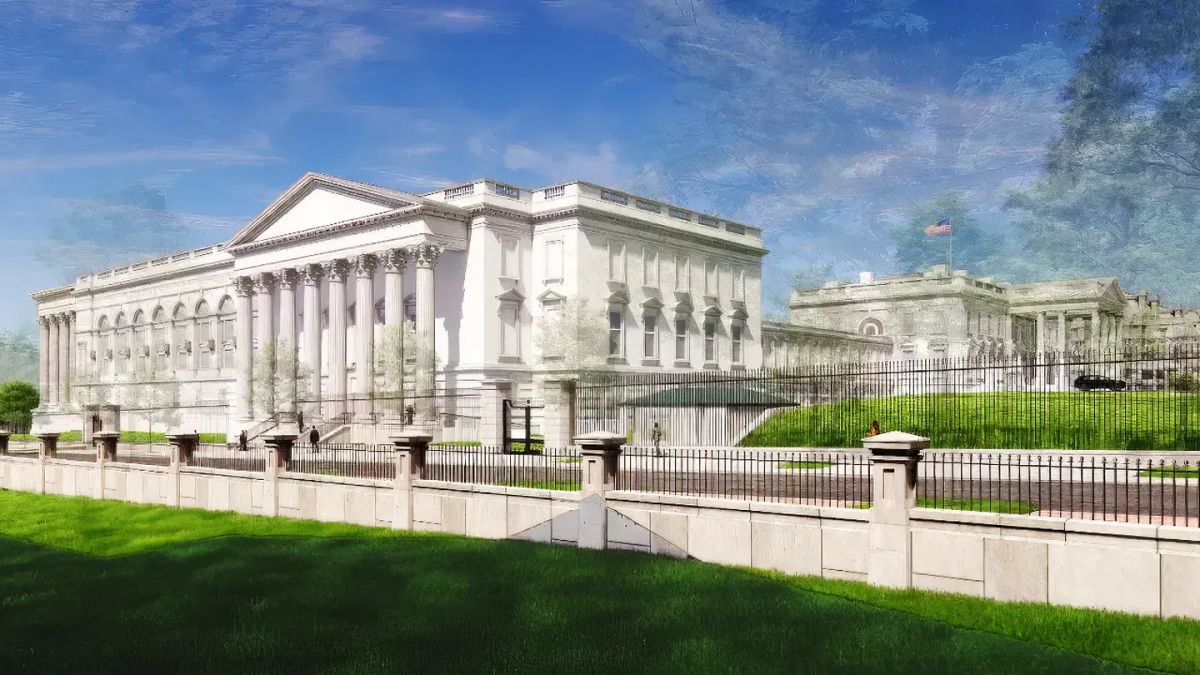
If you are an American taxpayer, public records suggest you were always going to be paying for that White House ballroom. The ballooning cost was one sign: Were private donors contributing $200 million (July 2025), $300 million (October 2025) or $400 million (December 2025), and how would we even know?
Even before Senate Republicans proposed contributing $1 billion in public funds to the White House's gargantuan renovation, The Redoubt uncovered federal contracts for work directly related to the project totaling more than $380,000, including costs associated with the demolition of the White House East Wing. There are also now at least three instances of a company working on the ballroom receiving a no-bid contract from the Trump administration — two of which are for work elsewhere in Washington.
In October, 2025, public records show that M.C. Dean, a Virginia-based contractor that regularly performs electrical- and security-system related work for the federal government, was awarded $138,150 for what is described, with a typographical error, as “EASY WING CAP AND DISCONNECT UTILITIES.” That money was awarded under an existing Blanket Purchase Agreement, which allows the federal government to fast-track the procurement process with pre-vetted contractors.
Work under the contract began Oct. 9, 2025 and was completed by Feb. 6, 2026. Construction of the White House ballroom commenced last September; the demolition of the East Wing began Oct. 20.
Federal records show that another $17,217 contract was awarded to Convergint Technologies, an Illinois-based firm that specializes in security and fire alarm services. That work is described as “WHITE HOUSE EAST WING GIANT VOICE & FIREWORKS DISCONNECT PROJECT,” with a listed start date of Dec. 3 and end date of Dec. 19, 2025.
In February 2026, meanwhile, the Executive Office of the President awarded just under $225,000 for an environmental assessment to the infrastructure consulting firm AECOM. While it appears that work is related to the ballroom, on which the company is the lead engineering contractor, the assessment in that contract is identified as being performed at a zip code — 20543 — that is exclusively associated with the Supreme Court (EOP is not responsible for work on a separate branch of government). The contract is notable as, last year, the Dallas-based company refused to disclose whether its ballroom work was awarded on a competitive basis.
Trump's return to office has been a boon to the company's finances. Fiscal year 2025 was the best on record for AECOM, at least in terms of its business with the federal government, the firm having been awarded some $24.4 million in contracts, almost exclusively from the Department of Defense; its next best year was fiscal year 2024, when it received $7.4 million.
No-bid deals
AECOM is not the only company working on Trump's ballroom that has received a no-bid contract.
In February, The Redoubt revealed that Clark Construction, the firm that is leading the construction of Trump's ballroom, was awarded a no-bid contract worth nearly $34 million to demolish historic buildings at Department of Homeland Security headquarters. The New York Times subsequently reported that the company received another, $17.4 million no-bid contract to repair fountains across the street from the White House at Lafayette Park.
As a major federal contractor, Clark Construction could have received those projects through a competitive bidding process. In both cases, however, the company received millions of dollars more than the estimated cost of the work it performed, creating the appearance it was being rewarded by an administration that has previously handed out contracts on an explicitly political basis.
Those no-bid contracts are an indirect way taxpayers could be on the hook for Trump's ballroom. But the White House had previously insisted that all costs directly related to the project, from demolition to construction, would be covered by money donated from the likes of Amazon, Apple, Meta and Lockheed Martin.
“We did this, no charge to the taxpayer, whatsoever, this was all donations made by friends of mine and people that are, that love our country,” the American president boasted at the Feb. 21 National Governors Association dinner hosted by the White House. “Not one penny,” he continued. "So important to say, because nobody ever reports it: it will be totally, totally tax free. Not one penny of tax will be donated to this.”
It is possible that the ballroom-related contracts, derived from public funds and identified by The Redoubt, were ultimately going to be paid with corporate donations — although the opaque nature of process would have made that difficult to verify. Now, though, the White House is not bothering to reconcile previous statements with its open welcoming of taxpayer funds.
On May 5, Trump administration spokesperson Davis Ingle told reporters that the $1 billion in taxpayer dollars, earmarked for the U.S. Secret Service and "security adjustments and upgrades" at the president's 8,300-square-meter event center, was "long overdue." Finally, Ingle said, public funds will be used "to fully and completely harden the White House complex."
 Charles R. Davis
"An atrocity"
The costs won't end there, however, as historian Edward Lengel told The Redoubt. Such a massive building will require ongoing maintenance and "doesn't exist in isolation," noted Lengel, who served as chief historian at the White House Historical Association from 2016 to 2018 and is the author of a biography of America's first president, "General George Washington: A Military Life."
"It isn't like some kind of set apart property that you can come in and just say, 'Okay, we're going to demolish this and we're going to build that and have these private donors pay for the construction, or pay for this and that, and it won't affect anything else," Lengel said. "There is a deep and extensive infrastructure that connects it to other adjacent properties."
This original reporting is funded entirely by readers like you. Support us with a paid subscription or one-time donation.
But not all costs can be quantified. Lengel maintains that the price of building such a massive ballroom is more abstract and damning — indeed, he sees the project as a rejection of the country's republican traditions. Events on White House grounds have always been performances that reflect values, including a pronounced refusal, historically, to embrace the pomp and excess associated with foreign monarchs and less democratic nations. President Washington, for example, believed White House events "should be dignified — with the proper gravitas; splendid, but not ostentatious. There was a deliberate purpose there."
"That's the irony," Lengel continued. "These people call themselves conservatives. They say they believe in the founders and American history. You can make an argument for building a ballroom like this, but it's not a conservative argument."
"It's totally untethered from what the founders intended the country to be," he said. "It's fundamentally changing the nature of how the country was supposed to be represented, symbolically."
"I just think what's going on is an atrocity," he added.