Trump's ballroom reflects 'hatred for American democracy': White House historian
Edward Lengel, a White House historian, says Donald Trump is showing "contempt for the founding fathers."



The gigantic ballroom that Donald Trump is trying to build on White House grounds is a venue for corruption, the U.S. president's donors and favorite contractors set to receive tens of millions — potentially billions — of dollars in taxpayer money after agreeing to help construct an entertainment complex fit for a king.
But the appearance of impropriety is perhaps not the most interesting or alarming aspect of the project. There's also the matter of symbolism, and what the building of a massive event center on formerly humble grounds says about the state of American democracy and the values of the United States' political and corporate elites.
In a conversation with The Redoubt's Charles R. Davis and historian Shirin Sadeghi, co-host of Critical Support, Edward Lengel argued that Trump's vision for the nation's capital is an affront to the legacy of those who founded the U.S. government. Lengel, former chief historian at the White House Historical Association, said that America's "founding fathers" wanted to project humility after throwing off the shackles of monarchy; to enshrine republican values in the very architecture of the U.S. government.
Whatever one thinks about America's founders — or the sanctity of a White House built with slave labor — Lengel said Trump's rebuke of his predecessors and their notion of an understated, people's house, should trouble Americans of all political persuasions. Describing himself as a conservative-leaning independent, Lengel admits he once underestimated the president's willingness to literally destroy the country's institutions.
"I think he's developed a hatred for American democracy," Lengel said, "and I think that this is something that is really manifest in what he's doing now."
CHARLES R. DAVIS: Our guest today is Edward Lengel. He was the chief historian of the White House Historical Association from 2016 to 2018 and he's the author of "General George Washington: A Military Life." Edward is also somebody I reached out to a few weeks ago now, because I was working on a story about the White House ballroom, and my angle was the corruption of it. I wanted to figure out if any taxpayer money was going to this giant monstrosity on the White House grounds, but talking to Edward, I ended up on a different, slightly more interesting topic, which was the symbolism of it all.
Edward did write the book on George Washington, so he knows a thing or two. One of the more interesting things he told me was that, you know, corruption aside, the founding fathers did not want what Donald Trump is building. They did not want a big palace for American government, right? They had just broken from the British monarchy, so they wanted to get away from all that extravagance. So, what actually bothered Ed a little bit more than the corruption — although I don't want to say he's not bothered by that — was the symbolic affront to the American democracy [and] the American project that he sees this as representing.
So, with that being said, Ed, I wonder if you could explain a little bit more why you think the White House ballroom is an affront to the symbolism that the American founding fathers wanted.
EDWARD LENGEL: Good morning, Charles. Good morning, Shirin. It's great to talk with you — and Charles, I think your earlier reporting and investigation on this has really proven prescient. The administration really was planning all along, from the very beginning, to use significant taxpayer funds on this, and now that's out in the open with the request for a billion dollars. I think that was intended from the very beginning, and certainly the symbolism of it has now been recognized in the various lawsuits that have been delivered against the administration.
I've had no part in those lawsuits. I've been following them from a distance, but ... I have been arguing from the very beginning that this administration's demolition of the East Wing, plans for the ballroom, and now many of the other things that are going on, including the UFC fight that's going to take place [June 14], are all running directly counter to and really antithetical to the founders' intent for the White House and the founders' recognition that the White House had powerful symbolic value — which continues to the present day — which required careful management. So all of this is very timely, and I appreciate connecting with you about it.
DAVIS: Now, of course, Donald Trump says that, going back generations, that every U.S. president has wanted a massive ballroom like this. Is he wrong?
LENGEL: Well, he, in his early comments, he said: "Oh, presidents have wanted this for a century." And I went on a on a talk show, and they brought that up, and I said, well, actually, that goes back practically to the very beginning. In fact, even Andrew Jackson had his tumultuous inauguration party, which then spilled into the White House, and kind of took it over, and forced poor Andy Jackson to jump out the window because there wasn't enough room for all the guests.
So he's right in the sense that the White House has always had limited functionality for entertainment. But where he's wrong is that that limited functionality for entertainment has always been deliberate. George Washington intended, from the beginning, that — along with [Thomas] Jefferson and the others — that yes, there would be entertainment; yes, there would be functions at the White House; but that they would be restrained. They would represent elements of gravitas and decorum and dignity, and that deliberately they would be more like house parties rather than gigantic public spectacles and entertainment, particularly for the elites.
What the current president is asking for, as I'm arguing now — you can make an argument for the ballroom. Absolutely. But it is not a conservative argument. It is not in any way aligned with a conservative interpretation of the republic and of the democracy that it represents. It is a radical argument. It is an argument that is antithetical to the founders' intent, and I think that's really suggestive for the type of administration we have.
 Charles R. Davis
DAVIS: When you say that the founders did not want a big, expansive White House grounds for parties, they kind of knew that they were limiting themselves. Was that just a matter of like taste and decorum, or were they trying to suggest something political about this decision?
LENGEL: So, some of the people who have been apologists for the administration, have said that in the early days there was talk about what became the White House actually being a "palace" — that the word palace was used. And also they've stated that George Washington imagined that this would be somewhat bigger than it actually turned out to be, and that's correct.
If you go back to the very, very early days, I mean, even before architect James Hoban came in and won the competition for designing the White House, Jefferson, from the very beginning, was opposed. He wanted the White House, or the executive mansion, to be smaller. He wanted it to be a house. He wanted it to be built out of brick instead of carved stone, which is something that Washington brought in.
However, I think just kind of bringing it all down into a nutshell: through their debates at a very politically divided time, and then when Jefferson left the picture and Washington was left pretty much in charge, working with James Hoban, Washington deliberately decided that yes, this would be built of cut stone, but it would no longer be considered a palace. That was a deliberate decision; that it would be considered a home and a residence, and that its size would be in alignment with the young republic's stature — that it would not be an excessively large edifice.
And he designed it with James Hoban to represent a democratic conception of the president as the nation's first gentleman, or first American, and not as anybody more exalted than that. So it was deliberately designed not to be a palace, not to be about entertainment, primarily, but to be a residence, and that was considered essential for their conception of American democracy.
This original reporting is funded entirely by readers like you. Support our work with a paid subscription or one-time donation.
SHIRIN SADEGHI: Why should we care if Donald Trump is not revering the heritage of the White House? I mean, is it almost like Donald Trump is "woke" — that he is saying, "I'm not going to respect tradition. I'm not going to accept authority on these matters."
I mean, the White House has a pretty dark history. It was built by slaves, and you know, black people's entrance into the building for a very long time was limited to servants. Why do we care? Tell us, why do we care? Why should we be concerned if Donald Trump is not adhering to the wishes of the founding fathers on the White House?
LENGEL: Thanks for the great question, Shirin. I think there are a couple of aspects to this. One is for what it reveals about the administration itself.
For me personally, I'm a more or less traditional historian. I'm not a very political person, but I would say I'm generally fairly conservative in my instincts. It reveals that this administration, this current administration, has nothing but contempt for the founding fathers, despite all that it hides itself in the trappings of liberty in America 250 — and there's a lot of talk about we believe that the traditional American history needs to be taught in respect for the founders, you know, and so on and so on and so on. This episode, more than anything else, reveals that the administration has no understanding of the founding intent and really doesn't care.
It even goes down to the little things. I got myself an annual national parks pass the other day, and not realizing the form that the parks pass took. And they handed it to me, and there's a picture on the pass, obviously deliberate, with Trump's face right next to George Washington, and even overshadowing George Washington. For all that many conservatives complain about the 1619 Project, this administration doesn't care about the founding fathers and founding intent any more than the 1619 Project does. This is not a conservative administration, it's a radical populist administration, so that in itself is revealing.
The second part that's very important here is that certainly, you know, critics of the founding fathers look at slavery and they look at the fact that enslaved people built these buildings and all of that is a is a very important subject. But I think what everybody should be able to agree on is that the structure of this country's government, the symbolism and the constitution and the fundamentals of American democracy, are essentially important. They're fundamental to the stability of our nation, and the fact that this government really has outlasted any other government on the face of the earth.
This development, the demolition of the East Wing, but even more than that, the building of this gigantic ballroom overshadowing everything else, fundamentally changes an essential symbolic element of American democracy. It changes the epicenter of executive power from being a relatively humble residence that represents the chief executive as a person of the people who is living in the people's house and changes this permanently — and permanently is the essential word — into essentially a party central, a playground for the elites, a Mar-a-Lago type residence.
This is a fundamentally important issue. Do we want our chief executive to be the chief elite who plays with, for example, Big Tech leaders and the super wealthy in a gigantic ballroom that is inaccessible by the people? Or do we want that person to have some anchor in America, in general, in the American people, in general? So I think this challenges the fundamentals of our democracy.
 Charles R. Davis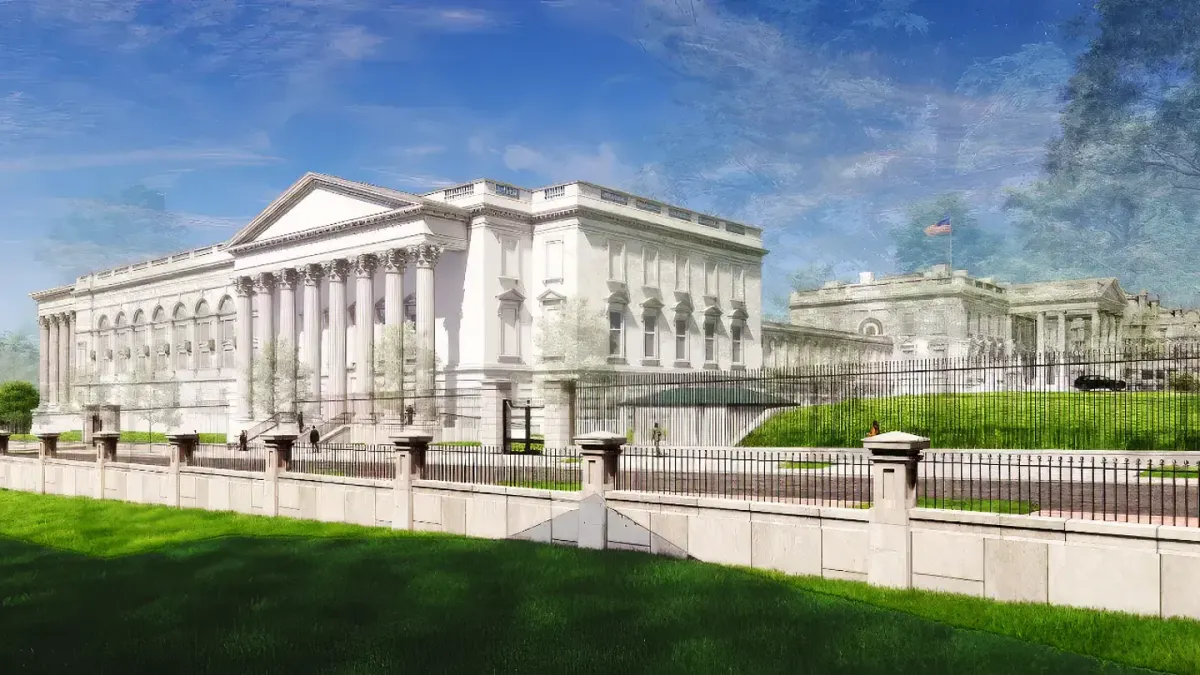
DAVIS: Now, Ed, you said the administration's treatment of the White House grounds is not conservative, and it's definitely, I guess, not small "r" republican. But I'm wondering if you're at all surprised by the overall politics of this and the broader conservative movement's response to it, because I know — as Shirin was kind of getting with her question — the kind of absurdity that I face is that it seems to be ... putting people like myself in a weird position where we say "Donald Trump must respect our national heritage, our history." It's like me complaining to my conservative relatives, "Don't you care about what's happening to the East Wing? Don't you care about the Kennedy Center, and stuff like that?"
And it's just kind of weird that it's kind of been inverted, right? Those of us who would consider ourselves more liberal and progressive ... we've been thrust into this position of like defending our national, iconic architecture and our nation's history, whereas it seems like the broader conservative movement has just kind of gone along with Donald Trump, who, as I said, is not really representing a small "r" republican tradition when he does this.
LENGEL: Also a great question. So, I have talked with a lot of friends about this, and also influencers, and I read the opinion columns in different newspapers. For example, I read the Wall Street Journal fairly regularly and I see that many conservatives, especially thinking conservatives, do recognize that this is appalling. For example, when I put up some commentary and I was quoted extensively in the Huffington Post, obviously a liberal outlet about the UFC fight, one of my very conservative friends commented that this whole UFC thing is disgraceful. And I have also seen other conservatives kind of very critical of what's happening, shocked at what's happening, for example, Peggy Noonan, who writes for the Wall Street Journal in the opinion [section]. Very, very important, kind of an older style Reagan conservative, she was a speech writer for him, [and] is also highly critical of what's going on.
But then those who have kind of sold themselves to cling to Trump and the Trump administration as being the only force that can prevent "woke" from taking over the world? They are willing to kind of contort themselves into all kinds of mental gymnastics to defend this. And the most ironic thing is I hear those people saying, "Well, Ed, don't you think that we need to update the founders? Don't you think you know that the founders' vision is no longer really relevant today, and we need to change it to suit modern times?"
And I just laugh, and I say, you know, there are many progressive legal theorists who would agree with you completely. That's the whole progressive argument for why we need to, for example, update our view of the Constitution and legal theory and everything else, is that the founding vision needs to evolve with modern times. So you see these people now using progressive arguments to defend what Trump is doing, and I've never seen anybody address that hypocrisy, and I have yet to see anybody, anywhere, argue against the statement that the founders did not intend this for the White House. Nobody has tried to engage with that argument. What they do is, when push comes to shove, they discard the founders and they embrace Trump. I find that very troubling, but I also think it again reinforces the argument that this is not a conservative administration.
SADEGHI: Ed, you mentioned earlier about the system that would, that produced the White House, the system that was made by the founding fathers. I know growing up in the U.S., our government teachers and our U.S. history teachers throughout elementary school and high school and all that, they repeatedly would tell us that the U.S. system is unique because it has checks and balances. And it just looks like, over and over again, the Trump administration has proven my high school history teachers to be wrong.
Has he in any way actually violated the Constitution by making these changes to the White House by putting a UFC, I believe it's called cage, on the White House lawn? Tell us more about that.
LENGEL: I'm not a legal expert, I was skeptical that it would be possible to stop the administration from doing what it wanted to with the White House, and the reason for that is that there are a lot of loopholes and a lot of vague kind of areas for who is really in charge of the overall kind of structure of the White House. funding for the White House. Certainly the administration thought that simply by circumventing Congress, by getting private funding initially to fund this construction of the ballroom and demolition of the East Wing, that they could circumvent Congress's control over the power of the purse.
Traditionally Congress has had to authorize any major changes, because Congress has had to publicly fund that. Now, I was skeptical that anybody could stop them, but I think the National Trust for Historic Preservation and other organizations that have mounted legal challenges to this have have really shown that there can be a very powerful argument to make to be made that what the administration is doing is illegal. And they have been able to get a number of stays on this construction; it's gone through the courts, it's now with a federal appeals court, I believe, and from initial indications the appeals court seems to be questioning the administration's moves as well.
In fact, there was an interesting exchange recently where one of the judges said that, so if the administration decided they wanted to bulldoze the Statue of Liberty, and they just did it right now before anybody could stop them, are you saying that would be legal? And the lawyer for the administration said, "yes," that would be legal. So, clearly, the administration thinks that they have practically unlimited power over the symbolism and the edifices of our country. Part of what's happening here is the administration's standard MO, which is that as soon as you try to block them on one thing, the administration will snowball you with a dozen other things that will overstretch you and make it impossible for you to stop them.
Thus, what Trump is doing with, for example, trying to build his triumphal arch; with painting over the Eisenhower Executive Office Building; with having this UFC cage fight; and then talking about making the arena permanent. All of this is specifically designed to kind of drive his opponents into kind of a hysterical state to try to over-defend everything, so that Trump can get through the things that he really wants. And it's important for those of us who oppose the administration on these things to stay focused and not to take a lot of what he's doing seriously.
For example, when I look at the UFC fight, I think it's atrocious, but I don't get overwrought about it, because this is just what Trump does, and when he talks about making the arena permanent, I just laugh. No, the Democrats are going to come back in, [and] if he leaves the arena there, they're just going to tear it down. And, in fact, it's a gift to Democrats. This whole thing has been a huge gift to the Democratic Party, and I think is driving independents like me, for example, over to their side and against the administration. I think they're going to pay a big political price for this.
DAVIS: That's actually a perfect segue to another question I wanted to ask you. Let's let's fast forward, let's say we don't go down the darkest timeline, that we have a free and fair presidential election a few years from now, and let's just say, hypothetically, a unity Democratic-Republican ticket comes in — so we're not going to get partisan here — and they invite you in to say, "What should we do with the White House grounds?"
Let's assume the ballroom has been built. What would you advise them to do? Because I've seen a couple different proposals. I think you know your partisan Democrat would like to see it razed; they don't want to see anything that Donald Trump built outlast him or his administration. On the other hand, I've seen some people propose that we turn it into a museum, perhaps to recognize the enslaved people that Shirin referenced earlier, who helped to build the White House.
What would you say to any future administration that is asking what they should do with what Donald Trump has done to the done to the White House grounds?
LENGEL: Well, there are two things that could possibly happen here, and kind of connecting with what I said earlier, that this is such a big gift to opponents of the administration and to the to the political left in general. All of these things that he's doing and talking about doing — even down to the putting his putting his picture on the on the national parks pass; he's talking about putting it on the currency; trying to put it on the Kennedy Center — is building up his political opponents to this desire for a radical demolition of all of the symbolism that Trump tried to create.
I mean, his opponents are are just rubbing their hands with glee and looking forward to tearing this all down, and it's going to be, I think, a great catharsis for people who despise Trump, and I think people in the political middle, like me, are going to stand by and say, "Yeah, you go get them, go for it, tear it all down." I think that emotion is building and that anger is building — that Trump's attempting to create this permanent legacy is motivating people more to erase his legacy, and I think that's going to be the likely result.
Democrats are going to run into a problem if the White House [ballroom] is built simply, and Trump knows this — the amount of money that would go into building the ballroom would mean it would be extremely expensive to demolish the ballroom. That's the biggest problem, and that's been his argument from the beginning, which I think is why Democrats deliberately are trying to postpone this and drag this out, so that he can't get the ballroom built.
If, for some reason, he is able to build the ballroom, I think a lot of Democrats, like you say, are going to want to just tear the thing down. But I think more likely what's going to happen is they're going to repurpose it in some way that will be a deliberate kind of counterpunch to this administration, say turn it into the Joe Biden Center for the Commemoration of, you know, Enslaved Labor at the White House. Something like that is very, very likely to happen, because they're going to say, "Look, there's another way to give it to them." They're going to say, "Trump and the Republicans wanted to turn this into a playground for the elite. We're going to turn it back into something directed at the common people, at the common American people." And that's going to give them a very compelling political argument.
If it was just me, and if the ballroom is built, I would say repurposing in some way is probably the best way to go. But the tragedy of this is that Trump, by what he's doing now, is turning the White House into something it was never meant to be, which is an area for partisan debate. He's turning it into a battleground, and that again is specifically something not only the founders, but every president, practically right up to Trump, has respected — that vision, that the White House, whatever else we may fight in any other kind of battlegrounds, the White House will always remain politically neutral. Trump, more than anybody else, has turned this into a partisan battleground, and unfortunately, that may be permanent.
 Charles R. Davis
SADEGHI: Ed, you were the chief historian of the White House Historical Association during Trump's first term. Can you tell us a little bit about what was the mood then? Did you see something like this coming? Have you ever met Donald Trump? Tell us a little bit more about your personal involvement with the Trump administration and sort of the integrity of American political establishments and architecture.
LENGEL: The White House Historical Association is an independent nonprofit, and it was in fact founded by Jackie Kennedy back in the 1960s initially to focus on preservation of the interior of the White House, the artifacts, and so on. But it is the White House Historical Association, and in fact, right up to the to the present day, the association, and certainly, when I was there, was focused not just on the interior of the White House, but also on the architecture of the White House itself.
I will say, by the way, I think the behavior of the White House Historical Association currently is craven and is disgraceful, and that they have made no effort to protest what the administration is doing — certainly no effort that I have seen. In fact, they have just kind of cravenly gone along with everything that's happening. And they say, "Oh, well, we're not really about the White House anymore, and that we, you know, we're not part of the administration."
To me, that's an argument for why you can stand up and make your voice heard. You don't report to the White House. You are an independent voice. You can say, "Wait a second, this isn't consistent with the history of the White House." So they're not doing that, and I think that's really terrible. When I was there, and given the fact that this is an independent association, I did not report to the administration, so I didn't have to, you know, go along with them, and I've never met Donald Trump.
But I did see a lot of what was happening, and I remember when Trump was inaugurated, I was at the association, I was there while in the latter stages of President Obama's tenure, and then for Trump we got a lot of contacts from the media saying, "Well, what's going to happen, is Trump going to repaint the White House gold, is he going to do this and that?" And I kind of scoffed, to be honest. I said he's not going to do that, he's not going to change the White House in any significant way, and I didn't hear any scuttlebutt at that time that he was going to demolish the East Wing. The administration did not, so far as I'm aware, pressure the association to say this or that about what was happening at the White House, so I enjoyed the luxury of being to some degree a neutral observer of what was happening.
One of the reasons I quit the White House Historical Association in 2018 is that the association seemed focused on just happy talk. No, we're just going to talk about all the fun things and the trivial things that happened at the White House, and we're not really going to talk about the meat of why the White House was built and what it represents. And so to me that was not intellectually satisfying, and I moved on, so I didn't get kind of the insider vision.
But I think what I can say is that all of what Trump is doing now, I think, is something that he was meditating in his rage over his various prosecutions and legal issues and the run-up to the 2024 election. I think he decided he's going to blow the place up, he's going to blow the country up. I think what he's doing is, in a lot of ways, a highly emotive reaction and a desire just to bulldoze everything. And people are not seeing that I think he's developed a hatred for American democracy and I think that this is something that is really manifest in what he's doing now.
DAVIS: Well, Ed, like a lot of our guests, I bet you wish on some level that your expertise were a little bit less relevant these days. We've had on other guests who are experts on, like, birthright citizenship, for example — this is a professionally very good time for them, but I think they would actually prefer that their books weren't selling as well, for example.
That being said, I thank you for bringing your expertise to our audience at here at Critical Support, you've definitely enlightened us to somehow some of the history and why it still matters today, and why you think it's not just "Trump derangement syndrome" to be a little bit upset about what's happened to the White House.
LENGEL: Yeah, thank you for that. I will say I didn't expect any of this to happen, and I certainly was not seeking the limelight on this, because I was kind of dozing along in the various books and projects that I have that I have happening right now, which really have had nothing to do with the White House in the recent couple of years. And then when this story blew up, because various media outlets tried to contact the White House Historical Association, and the association refused to talk with them, they found me and contacted me. So, as a result, I'm talking all over the place about the White House.
And yeah, this is not something I necessarily want to talk about, because this is a terrible thing that's happening. But when somebody asks me what I think, I'm going to say what I think, and, and it is at least satisfying in some ways to say I spoke up against what was happening. And I wish many of my fellow conservatives would do the same thing — just say that this is wrong, you know. Don't be afraid. You have to stand up for the founding vision of this country.